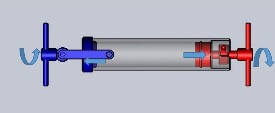
The BGD 297 Pressure Density Cup is designed to measure the density of liquid samples with minimal error. Some paints tend to incorporate significant quantities of air during manufacture. The instrument compresses the paint so that any entrained air bubbles are reduced to a negligible volume. It can be used with materials containing up to 10% entrained air by volume and provides results with a reproducibility better than ±0.5%
The instrument consists of a hollow cylinder with a plunger at one end and a pressure-release cap at the other. Pressure is applied to the paint sample by advancing the plunger using the screw provided. Excess paint is expelled through the pressure-release cap, which is set to 150 psi. When the plunger is fully advanced, the enclosed paint occupies a volume of 100 ml
The pressure density cup is made of stainless steel and is easy to clean
Standards
ISO 2811-4:2011 — Paints and varnishes — Determination of density — Part 4: Pressure cup method
BS 3900-A22:1998 — Methods of test for paints — Part A22: Determination of density by the pressure cup method
Both standards describe the determination of paint density using a pressure cup
Technical Specification
To fill the cup, remove the pressure-release cap and fully retract the plunger to maximise the filling capacity. Hold the cup vertically with the open end facing upwards, then pour in the paint to be tested until the cup is nearly full. Refit the pressure-release cap to close the cup
Compress the paint by advancing the plunger. When the pressure in the cup reaches 150 psi, excess paint is forced out between the cup and the pressure-release cap. Once the plunger is fully advanced, the paint remaining in the cup is at a pressure of 150 psi and occupies a volume of 100 mL (equivalent to the volume of 100 g of water at 16.7 °C)
At temperatures other than 16.7 °C, thermal expansion of the cup introduces a small error. This error may be considered negligible at temperatures between 12 °C and 20 °C. Wash the excess paint off the top of the cup, then dry the entire instrument
Determine the mass of the paint remaining in the cup by weighing the cup and its contents and subtracting the tare weight of the cup