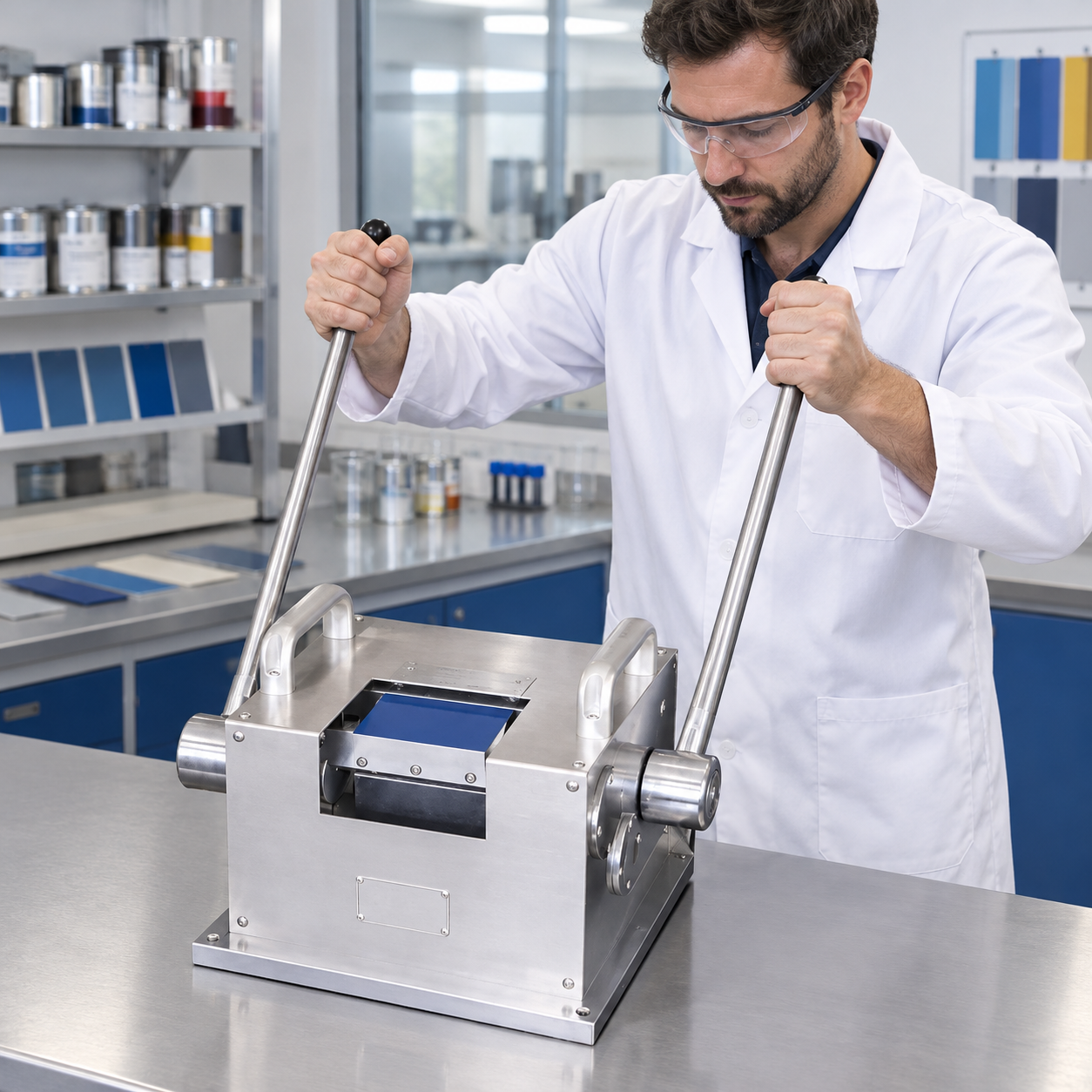
The BGD 568 T-Bend Tester is designed to evaluate the flexibility and adhesion of organic coatings on metal substrates. It assesses the coating’s ability to withstand bending without cracking or loss of adhesion. The test can be used to verify compliance with specified requirements or to determine the minimum bend at which the coating remains intact.
During testing, coated panels are bent back on themselves through 180°, with the coated surface on the outside of the bend. Different bend radii are obtained using spacers or mandrels. After bending, the coating is inspected for cracking using a magnifying glass, and a tape test is performed to check for loss of adhesion. Results are expressed as a T-bend rating.
Standards
DIN EN ISO 17132 — Paints and varnishes — T-bend test
ASTM D4145 — Standard Test Method for Coating Flexibility of Prepainted Sheet
EN 13523-7 — Coil coated metals — Test methods — Part 7: Resistance to cracking on bending (T-bend test) — Folding method
T-bend testing evaluates the flexibility and adhesion of coatings on metal substrates during bending and forming. DIN EN ISO 17132 provides a general method for assessing coating flexibility and adhesion, while ASTM D4145 focuses on prepainted metal sheets used in subsequent fabrication. EN 13523-7 is specifically intended for coil-coated metals and evaluates resistance to cracking during bending, with the folding method commonly used for routine quality control
Technical Specification
Maximum panel thickness: 1.0 mm for steel; 2.0 mm for aluminium
Panel width: Less than 100 mm
Weight: 50 kg
Overall dimensions (L × W × H): 350 × 300 × 190 mm