Technical Specification
Different lamp types are selected according to the test requirements, as each type has a different spectral distribution and irradiance output. Fluorescent UV lamps are generally classified as UVA or UVB lamps.
Typical applications include:
- UVA-340 lamps: UVA-340 lamps closely simulate the short-wavelength UV portion of sunlight in the wavelength range from approximately 295 to 365 nm.
- UVA-351 lamps: UVA-351 lamps simulate the UV portion of sunlight transmitted through window glass. They are particularly suitable for evaluating the ageing of materials used indoors.
- UVB-313 lamps: UVB-313 lamps emit short-wavelength UV radiation that is more severe than the UV radiation normally reaching the Earth’s surface, thereby accelerating material ageing. However, these lamps may cause damage that does not occur under natural exposure conditions. They are primarily used for quality control, research and development, and testing materials with high weathering resistance.
Product Features:
UVA or UVB Lamps Manufactured in the USA or Germany
The BGD 856 uses fluorescent UV lamps manufactured in the USA or Germany. These lamps are designed to provide stable UV exposure and support repeatable, comparable test results.
The lamps are designed to maintain a stable spectral power distribution throughout their service life, which may reach 6,000 hours. Longer lamp life reduces replacement frequency and operating costs.
The lamps are manufactured using fluorescent lamp technology developed over more than 40 years and are subject to stringent quality control.
Proprietary Ballast Technology
The proprietary ballast is designed to extend lamp service life to up to 6,000 hours, helping users reduce operating costs.
Automatic Irradiance Control
The BGD 856 uses a closed-loop control system to monitor and automatically adjust irradiance during testing, helping maintain a stable exposure level.
UV exposure is an important factor in polymer ageing. Consistent irradiance is therefore essential for repeatable and comparable test results.
The system continuously monitors irradiance and compares it with the setpoint. If the measured value falls below the setpoint, the system automatically adjusts lamp power to compensate.
Automatic Irradiance Calibration
Like all fluorescent lamps, BUV UV lamps gradually lose output over time. The BUV control system compensates for this reduction by progressively increasing lamp power.
As the lamps age, however, the system may eventually be unable to maintain the required irradiance, particularly at higher setpoints. This triggers a “High Irradiance Error” and an automatic shutdown. At this stage, operator intervention using the BUV irradiance calibrator is required.
The BUV system uses proprietary irradiance calibration technology. A single calibrator can be used with multiple BGD 856 testers and supports both UVA-340 and UVB-313 lamps.
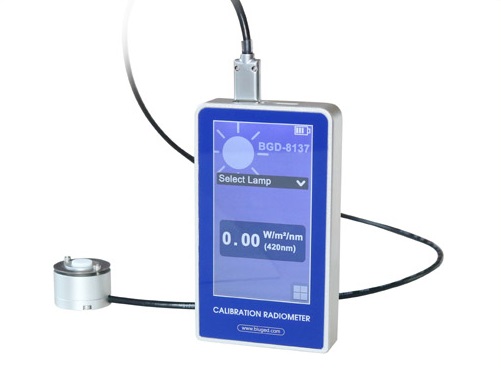
The calibration system consists of an irradiance meter with a display/control unit and an irradiance sensor or measurement probe.
A typical calibration procedure is as follows:
- During normal BUV operation, insert the calibration probe into the designated calibration port.
- Press the corresponding channel button on the calibrator.
- The system completes the calibration automatically, without manual calculations.
The BGD 8118/S calibration radiometer sensor is highly sensitive to UV radiation, does not respond to visible light and has a negligible response to infrared radiation. This minimises interference from radiation outside the intended measurement range.
Water Spray and Condensation Functions:
Water spray
For certain applications, water spray provides a closer simulation of end-use environmental conditions. It can simulate thermal shock caused by sudden temperature changes, as well as the effects of rain.
For example, a sudden rain shower on a sun-heated surface can cause a rapid temperature change, placing considerable stress on the material. The BUV water spray system is designed to reproduce these conditions.
The spray system has 12 nozzles, with six on each side of the test chamber. It can operate for a few minutes and then stop. These short spray periods rapidly cool the specimens, creating thermal shock conditions.
Condensation
In many outdoor environments, materials may remain wet for more than 12 hours a day. Dew, rather than rain, can account for much of this surface moisture.
The BUV tester simulates these conditions using a controlled condensation cycle. Water at the bottom of the chamber is heated to generate water vapour, maintaining a warm chamber atmosphere at 100% relative humidity.
The specimens form part of the chamber wall. Their test surfaces face the warm, humid chamber interior, while their reverse sides are exposed to the cooler ambient environment. The resulting temperature difference causes moisture to condense on the test surfaces.
Automatic Temperature Control Using a High-Precision Pt100 Sensor
The black panel temperature can be controlled at a specified setpoint during each test cycle. A black panel thermometer continuously monitors the temperature
Higher temperatures can accelerate material ageing, while accurate temperature control helps ensure test reproducibility
The black panel thermometer consists of a Pt100 sensor and a black-coated metal panel exposed to the same conditions as the test specimens. It provides a reference temperature representative of the exposed surfaces
The temperature setpoint can be selected to suit the test requirements and controlled automatically throughout the test. The thermometer can also be calibrated periodically
Control and Monitoring:
Programmable Test Cycles
Operators can create test programmes to suit different standards or test methods
Each programme can contain up to 10 segments. For each segment, the operator can select one of four functions—UV exposure, water spray, condensation or end of test—and enter the relevant parameters
The BUV tester can store up to six programmes in permanent memory. Once a programme has been saved, it can be selected and run again without re-entering the settings.
Colour Touchscreen Interface
All control and display functions are accessible through a high-resolution colour touchscreen
The menu-based interface simplifies operation and maintenance. Operating parameters are displayed throughout the test, allowing the operator to monitor test conditions
Real-Time Data Logging and Export
The system collects and stores test data in real time. Recorded data can be converted automatically into Excel format and saved.
A USB port on the rear of the tester allows operating data for a selected period to be exported to a USB flash drive. This facilitates data review, statistical analysis and monitoring of unattended tests.
TCP/IP Ethernet Interface for Remote Access
The tester includes a TCP/IP Ethernet interface for remote monitoring and control over a suitably configured network
Once the appropriate IP address and network settings have been configured, the operator can monitor the tester’s operating status remotely
This function also enables Solvica to provide remote diagnostics and after-sales support
Built-In Booster Pump
A built-in booster pump enables the tester to operate when the external water supply pressure is insufficient
Alarm and Protection Functions
The tester includes alarms and protective functions for:
- Insufficient water supply
- Excessive black panel temperature
- Excessive deviation between the irradiance setpoint and the measured value


 Multifunction Irradiance Meter (UVA&UVB)
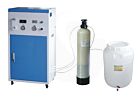 Purity Water System: 20L/h